
RESEARCH REVIEW / Age-Related Muscle Loss
4 Hidden Signs of Sarcopenia – And How to Spot Them
New Research Reveals Sarcopenia Symptoms, Causes, and Natural Prevention Techniques
4 Hidden Signs of Sarcopenia – And How to Spot Them
New Research Reveals Sarcopenia Symptoms, Causes, and Natural Prevention Techniques
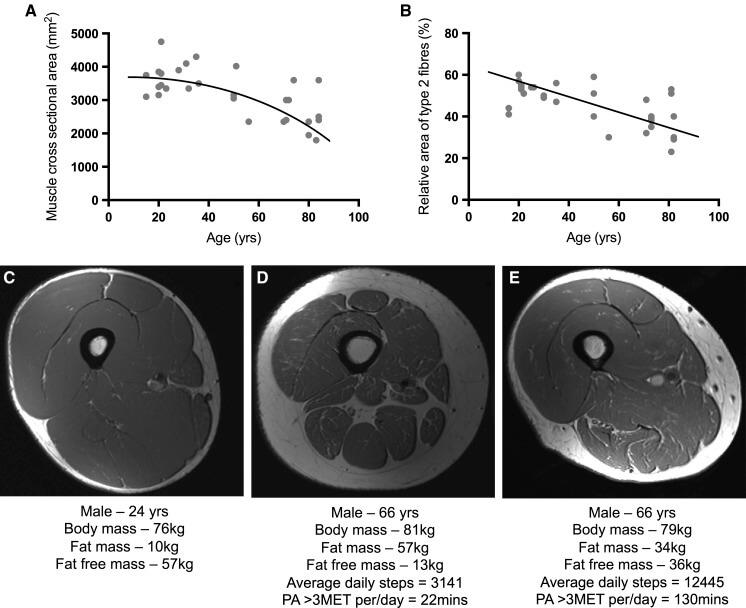
Depiction of skeletal muscle size by age (Source: "Live strong and prosper" by McLeod et. al, Biogerontology 2016, CC 4.0)
Depiction of skeletal muscle size by age (Source: "Live strong and prosper" by McLeod et. al, Biogerontology 2016, CC 4.0)
When you look in the mirror, do you see less muscle mass than you did just a couple of years ago?
If so, you’re not alone. Up to half of adults will experience this phenomenon in their lifetimes.1
This rapid decline of skeletal muscle tissue with age is called sarcopenia.
But a more common and accurate term for sarcopenia is age-related muscle loss, or ARM.
Because muscle loss is a visible process, most people assume that observing changes in muscle mass is sufficient to determine if they are experiencing ARM. But the “eyeball test” isn’t the best way to diagnose the problem.
Why?
Because by the time significant muscle mass is lost, ARM is likely well underway.
That’s why muscle weakness – or any noticeable decreases in strength – is a better place to start.
There is one specific test that is reliable, backed by research, and very easy to gauge: hand grip strength.2
Using a handheld device called a dynamometer, researchers can accurately assess and even predict ARM in people based on changes in their grip strength over time.
But even without scientific testing, just being aware of how easy or difficult it is to open jars or hold grocery bags can be helpful. Here are three other early signs of sarcopenia that are harder to spot:
-
Decreased stamina to endure physical activities, even walking, without early fatigue
-
Slower natural walking speed over time or compared to other people
-
Loss of balance especially while standing on one leg.
Recognizing the early signs of ARM is helpful. But understanding the root causes (and how to combat them) provides valuable insight into potentially preventing ARM in the first place.
What Really Causes Age-Related Muscle Loss?
Researchers at Johns Hopkins University found three key factors that drive age-related muscle loss:3
1. Declines in neuromuscular activity: Recent studies indicate ARM is not just loss of muscle tissue but declines in nerve signals to muscles. As the links between motor neurons and muscle fibers weaken, muscle tissue is lost. This has less to do with aging and everything to do with nerve signaling.4
2. Reduced muscle protein turnover: It may sound counterintuitive, but the inability to replace older proteins is a fundamental cause of age-related muscle loss. Although muscle mass appears as something unchanging, each muscle cell goes through a continual process of breakdown and replacement.
In many cases, it’s not muscle loss that is the fundamental problem. Rather, it is the inability to repair and replace older proteins.
3. Impaired muscle protein synthesis: Once again, the surface-level problem of muscle loss has pointed us in the wrong direction. A 2021 study published in Frontiers in Physiology challenged long-held beliefs about what causes ARM. Researchers concluded that the lack of an enzyme called mTOR is largely responsible for decreased ability to synthesize new muscle tissue with age.5 Fortunately, mTOR can be influenced by supplementing with specific amino acids — even in older adults.
Here's the key takeaway and pattern among these studies: though ARM is considered a normal part of aging, each variable can be traced to a specific physiological driver.
And each driver can be influenced through exercise, nutrition, and lifestyle.
Researchers in one study stated it even more bluntly: age-related muscle loss “should not be conceptualized as a linear process” that begins in middle age.6
We have more control over this process than we realize. And it boils down to three simple action steps.
The 3-Step Plan for Preventing Age-Related Muscle Loss
The research is clear. If you want to help safeguard your muscles from age-related muscle loss, follow these three steps:
1. Maintain neuromuscular signaling.
How? Through resistance training. Studies show that at least two full-body resistance training (weightlifting) sessions per week are all it takes to keep motor neurons engaged and muscle mass intact. Even one session per week may be sufficient to build and maintain muscle mass in older adults — with the right nutritional approach (see below).7
2. Improve muscle protein turnover.
Most protein supplements don’t address muscle protein turnover. The easiest way to bolster muscle protein turnover is to supplement with HMB. It’s a natural substance produced in our bodies from consuming the amino acid leucine. The problem is that it is virtually impossible to get the optimal amount of HMB from diet alone.
Research shows only around 5% of dietary leucine converts into the muscle-protecting compound HMB. That means you would have to consume about 600 grams of quality protein per day to get the clinically supported 3-gram dosage of HMB.8
A recent study in the Journal of Nutrition, Health & Aging found that HMB supplementation preserves muscle strength and function in older adults with age-related muscle loss. Even more encouraging, researchers observed that people who took HMB significantly increased lean body mass.9
(Important Note: not all HMB is created equal. More on this in a moment.)
3. Improve muscle protein synthesis.
This is not as simple as eating more protein. That’s because the bottleneck is the signaling process — not how much protein you eat.
As more of our existing exercise therapy clients and readers asked us about age-related muscle loss, it became clear that no viable solution in the marketplace addressed the problem.
So, we assembled the first all-in-one solution that addresses muscle protein synthesis, breakdown, and turnover.
It’s called Protein Clinic™
We loaded it with 33 grams of protein per serving and nine of the most critical ingredients for building muscle.
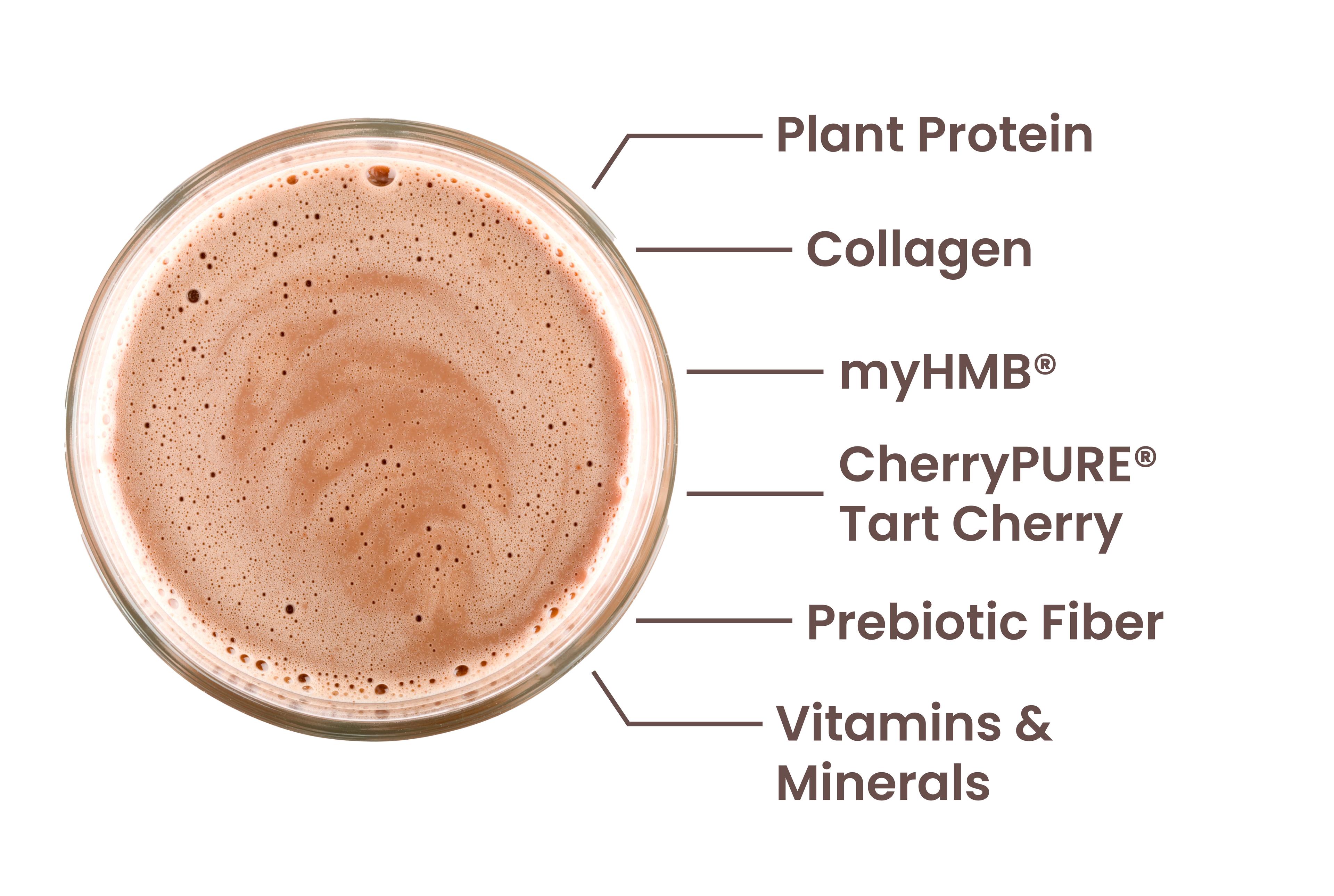
That includes clinically proven ingredients like myHMB®, CherryPURE®, and BodyBalance® collagen peptides.
Just drink one delicious shake per day to support muscle maintenance and growth. You can use it for meal replacement, post-workout recovery, or a delicious and protein-packed anytime treat.
We make Protein Clinic in a GMP-approved, FDA-inspected facility right here in the U.S.
And it’s made from natural, whole foods. That means no hormones or banned substances.
Because we formulated Protein Clinic based on client feedback, we released it first to a small group of clients and readers.
Here's what they had to say:
“Protein Clinic has everything I need in one supplement. It tastes great and it’s easy to digest."
-Joseph C., Protein Clinic User
“Protein Clinic is helping me go to new levels on the rings and bars while building lean muscle."
-Chris. C., Protein Clinic User
“The chocolate flavor is very good and the powder is easy to mix. Protein Clinic has all the important nutrients I need for football season."
-Alex U., Protein Clinic User
“Protein Clinic is absolutely amazing!"
-Brian K., Protein Clinic User
In fact, the feedback has been so strong that we offer a 90-day Love-it-or-Free Guarantee.
This means that if you don’t love Protein Clinic, we’ll refund your entire purchase.
No return necessary.
Seriously. We don’t make you jump through any hoops.
Simply email us or use the Contact Us page on our website if you decide you want a refund. We’ll take care of the rest.
That’s how confident we are you’re going to love Protein Clinic. (Even with this generous “no return necessary” policy, our refund rate is still incredibly low.)
Ready to protect your hard-earned muscle and boost your natural muscle-building potential at any age?
Just click the button below to learn more.
ABOUT SALTWRAP
Our mission at SaltWrap is to bridge the gap between sports performance and longevity. To provide the tools you need to stay healthy while tackling your fitness goals. We create solutions in the categories of nutritional supplements, books & media, and therapeutic fitness equipment — all designed to keep you healthy and performing at your best. Our products and content help you achieve your highest level of fitness, without sacrificing your health later. Read the full About Us page.
OUR REPUTATION
Do customers recommend buying from SaltWrap? See verified company reviews on Reviews.IO and Google Customer Reviews.
RESEARCH REFERENCES
1. https://www.ncbi.nlm.nih.gov/pmc/articles/PMC3060646
2. https://www.ncbi.nlm.nih.gov/pmc/articles/PMC5383622/
3. https://www.ncbi.nlm.nih.gov/pmc/articles/PMC4066461/
4. https://www.ncbi.nlm.nih.gov/books/NBK470413/
5. https://www.frontiersin.org/articles/10.3389/fphys.2017.00788/full
6. https://pubmed.ncbi.nlm.nih.gov/8563679/
7. https://www.ncbi.nlm.nih.gov/pmc/articles/PMC2465144/
8. https://www.ncbi.nlm.nih.gov/pmc/articles/PMC4799859/pdf/JCSM-7-068.pdf
9. https://pubmed.ncbi.nlm.nih.gov/30697623/
Copyright © SaltWrap, All Rights Reserved
*These statements have not been evaluated or approved by the FDA. This product is not intended to diagnose, treat, cure or prevent any disease.
Disclaimer Representations regarding the efficacy and safety of our products have not been scientifically substantiated or evaluated by the Food and Drug Administration. The FDA only evaluates foods and drugs, not these products. Nothing contained on this site is intended to diagnose or cure.
Should you have any health care related questions, please contact your physician. You should always consult your physician before taking any nutritional supplements, making changes to your health or fitness regimens, or implementing any health related advice. Results will vary depending on the circumstances of each individual. Prior results do not predict, warrant or guarantee a similar outcome. Read our full Disclaimer here.
This site is not a part of the Facebook website or Facebook Inc. Additionally, this site is NOT endorsed by Facebook in any way. FACEBOOK is a trademark of Facebook™, Inc.