Be built (to last).
The right supplements can help you recover naturally and build a resilient body.

Supplement Quiz
Take this short quiz to discover the perfect supplements for your needs and goals.
About SaltWrap
Built from Broken
Get the best-selling book from SaltWrap founder, Scott Hogan, and start rebuilding today.
Tendons and Longevity: An Interview With Dr. Jill Cook
By Joe Zagami
Tendon pain gets framed as a simple — and very common — story: “You’re getting older. That means your tendons are likely degenerating. But that’s ok, because this is just natural wear and tear.”
But that’s not the whole story. Far from it.
According to Dr. Jill Cook, one of the world’s leading tendon researchers with decades of experience on the frontlines of physiotherapy, the way most tendon pain gets framed is not just inaccurate — it’s often harmful.
Because here’s the thing: Tendon problems are rarely about age alone.
Rather, they’re about how load accumulates over time — and how poorly most people are taught to manage it.
We recently had the pleasure of speaking with Dr. Jill Cook. In this article, we’ll break down exactly what we learned from her, some of her best and most actionable advice, and how it can all help you come back stronger on your fitness journey.
Tendon Pathology Is Common, Disability Is Not
According to Dr. Cook, one of the most counterintuitive realities of tendon health is this:
“We know that a good percentage of people who develop pathology will have a full career with no pain, even though they have pathology in their tendon.”
In other words, “structural damage” does not automatically mean that you’ll experience pain or dysfunction. And it doesn’t mean that a rupture or other serious setback is imminent.
This is why medical imaging can be so misleading. MRI reports often use language like degeneration or partial tearing. It can almost instantly change how people think about their bodies — and how much load they believe they can safely tolerate.
For this reason, Dr. Cook cautions that medical professionals should look at the bigger picture of the patient’s situation rather than just the imaging.
“Deal with the person and their pain — not the words on the imaging report,” Dr. Cook says.
“You don’t treat the scan. You treat the person.”
Tendons Don't Fail Because of Age. They Fail Because of Load.
Dr. Cook emphasizes that most tendon issues sit on a spectrum. But the vast majority will be caused by one of these two common culprits:
-
Low load over many decades (e.g., shoulder tendons)
-
Extremely high load over a short time (e.g., young gymnasts with Achilles ruptures)
Both can produce tendon pathology. And, according to Dr. Cook, “If you don’t use your tendon in a high-volume or high-load way, you can avoid pathology. But on the whole, life does that to you.”
This reframes tendon pain as a use and load problem. Not a simple aging problem.
Tendons Don't Hate Load — They Hate Change in Load
Here’s a critical concept that every athlete and active person needs to understand, especially as they get older: Tendons are not fragile tissues. They are quite adaptable. And they tend to adapt best when loading is:
-
Gradual
-
Consistent
-
Predictable
In general, Dr. Cook believes problems begin to arise when loading changes too quickly. “Tendons don’t like change in load,” she says.
But when we say change in load, we aren’t just talking about weight being carried. Change in load can include sudden jumps in:
-
Volume of exercise/work
-
Intensity of exercise/work
-
Frequency of exercise/work
-
Introducing new movement types (like starting a new sprint program, etc.)
If you want to avoid tendon issues, keep this idea in mind: “Tendons don’t like surprises.”
The 24-Hour Rule: A Practical Way to Read Your Tendon
Of course, this idea presents a potential problem: Obsessing over tendon load.
Rather than obsessing over avoiding changes in tendon load or pain during training, Dr. Cook recommends paying close attention to how tendons respond after loading.
Here are the two indicators that matter most:
1. Morning Stiffness
Some degree of morning stiffness is normal. The key is knowing what is normal for you.
Dr. Cook says, “If you have five minutes of morning stiffness and you always have five minutes, your tendons are likely happy.”
2. Ability To Reload Within 24 Hours
We all need rest days. And some lingering soreness from a good workout is totally normal. But you should not feel like loading your tendons would be virtually impossible. As Dr. Cook tells us, “If you cannot reload within 24 hours, then that tendon isn’t happy.”
The big takeaway: Some soreness is normal. What really matters is symptom stability, not the total absence of any pain.
“Stable symptoms are more important than no symptoms,” Dr. Cook says.
"Stable symptoms are more important than no symptoms."
Dr. Jill Cook
Renowned Physiotherapist

Why Tendon Ruptures Are Nearly Impossible to Predict
When it comes to tendon pain and other issues, the one outcome that every athlete wants to avoid is a rupture.
Nobody ever wants to hear a popping or snapping sound and feel that sudden pain. Plus, with recovery typically taking anywhere from four to six months for a major rupture, it’s fair to say that we should try our best to avoid this outcome as much as possible.
But there’s a little-known, unspoken truth about tendon ruptures that every athlete and active person concerned with their tendons should understand: There is no good way to predict one. Even with medical imaging.
“We have no capacity to predict rupture. We cannot do it on clinical grounds. We cannot do it on imaging grounds,” Dr. Cook says.
But that doesn’t mean you can’t see the writing on the wall.
Pain is not necessarily a reliable predictor of a tendon rupture. But it can be a very useful message. One that’s worth listening to, especially if it doesn’t feel like traditional muscle soreness after hard work.
Dr. Cook tells us, “Pain gives you limits. If you don’t have pain, you don’t have limits.”
The good news is that there are ways to proactively strengthen your tendons so that you significantly lower your risk of facing a rupture, nagging pain, or other potential setbacks.
Slow, Heavy Training: A Foundational Strategy for Tendon Strength
When discussing what actually helps tendons adapt, Dr. Cook consistently returns to one core idea: Controlled loading.
According to Dr. Cook, “We know that isometrics and slow heavy resistance are good for the tendon. They make it stiffer.”
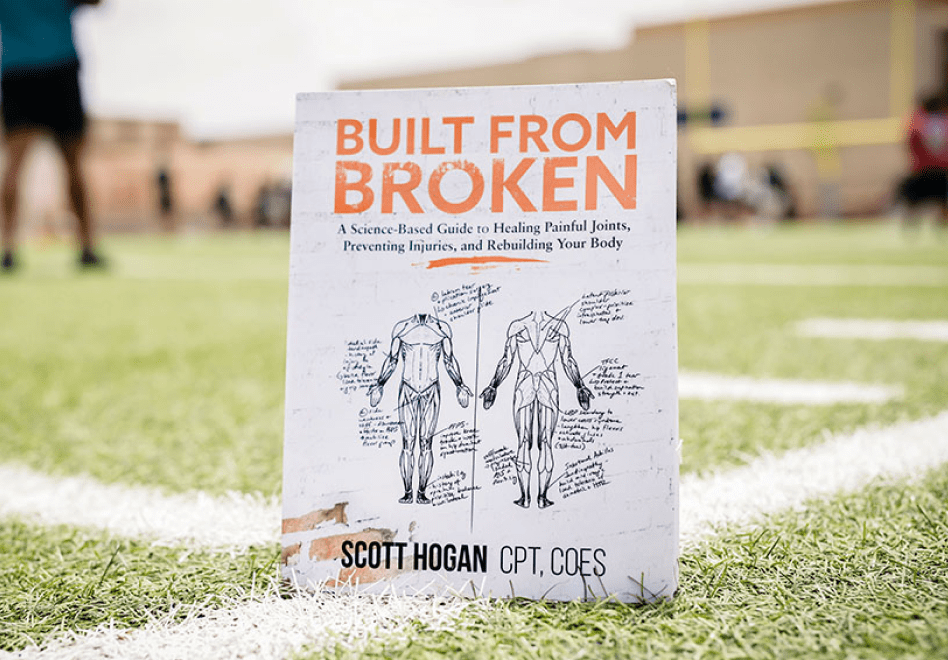
This is a key principle in Built from Broken.
But stiffness alone isn’t the only benefit, or even the main desired outcome. It’s overall joint and muscle resiliency.
And this type of training – slow, heavy resistance training – encourages both.
This is critical because tendons don’t work in isolation. Poor muscular strength, endurance, or coordination can put unnecessary stress on tendons, increasing the risk of injury.
Think of it like this: the better trained your muscles are, the better-equipped your tendons will be to handle the loads you put on them.
As Dr. Cook puts it, “Your tendon can only operate within safe limits if your muscle is perfect.”
That’s what makes slow, controlled resistance training so worthwhile. Because in addition to building muscle strength and size, it also helps improve:
-
Tendon stiffness
-
Muscle coordination
-
And neuromuscular control.
Dr. Cook tells us that when it comes to slow resistancetraining, especially in the context of building resilient tendons, “Control andendurance are just as important as strength.”
Muscle Endurance: The Missing Piece in Many Injuries
Another benefit of slow resistance training is safety.
The majority of tendon injuries don’t occur at the start of activity. They occur when fatigue sets in, and your form starts to break down.
“If you’ve got good strength but not good endurance, fatigue will change how the load is taken — and that changes the load on the tendon,” Dr. Cook says.
This is why endurance and coordination matter just as much as maximal strength, especially for repetitive sports like running, jumping, and throwing.
Stretching Doesn’t Fix Tendons (It Can Make Them Worse)
When it comes to stretching, Dr. Cook takes a seemingly controversial, yet very clear and practical position:
“Stretching is bad for tendons. Don’t do it.”
Static stretching often compresses tendon insertions. This is exactly where tendinopathy typically occurs. There’s also little evidence that it actually helps prevent injuries.
“Don’t add things that don’t give you any benefits. Give people three important things — not ten useless ones.”
Putting It All Together
Think of tendons as a lifelong partner in your fitness journey. With the right care and attention, you can reduce your risk of tendon injury and increase your resilience.
Perhaps the most important mindset shift Dr. Cook offered us is this: “Once a tendon, always a tendon.”
That doesn’t mean babying your tendons as if they could rupture at any moment. But it does mean having an extra layer of awareness and taking care not to put them under unnecessary stress by staying active.
Tendons will always be sensitive to changes in load. The goal isn’t to “cure” them of this — it’s to understand and manage them intelligently.
“You’re not going to cure people. You’re going to teach them how to manage it,” says Dr. Cook.
Tendon pain and degeneration aren’t simply a part of “getting older.” And neither of these things should be feared. Because when load is managed intelligently, and strength is built properly — patiently — tendons are remarkably resilient.
Remember, the goal is not perfection, or even zero pain.
The goal is to build strength, durability, and resilience — and learning how to come back stronger.
If you want to come back stronger but don't know where to start — or if you're ready to finally resolve nagging pain and injuries that limit mobility, movement, and comfort — then you owe it to yourself to check out the Revised and Expanded Edition of Built from Broken.
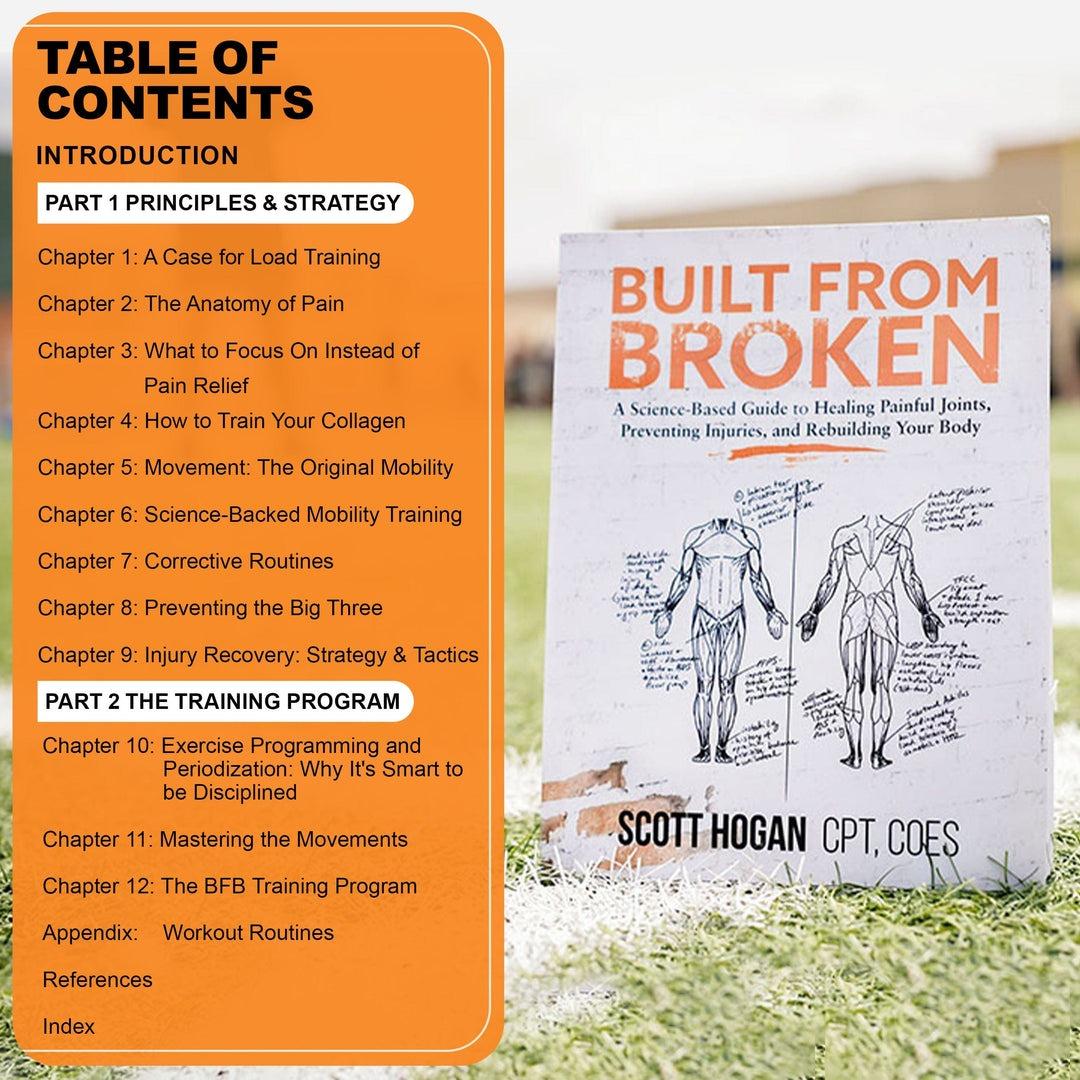
Now published by Authors Equity, the new edition of the award-winning and bestselling Built from Broken features:
-
Upgraded book design quality (lay-flat binding and a more reader-friendly trim size)
-
Updated workout program sections for smoother real-world use
-
Additional Exercise Appendix with page references for every movement
-
A brand-new Foundations Program to build balance, stability, and core strength before starting the main routines
-
Clearer details on the NRS Pain Scale, tempo, and exercise naming
-
And improved clarity and flow throughout — same depth, but now easier to read and apply.
Click the button below to learn more about the new Built from Broken.