

Be built (to last).
The right supplements can help you recover naturally and build a resilient body.

Supplement Quiz
Take this short quiz to discover the perfect supplements for your needs and goals.
About SaltWrap

Built from Broken
Get the best-selling book from SaltWrap founder, Scott Hogan, and start rebuilding today.
What Is Light Therapy?

By Dr. Ro Mahajan, MD
The practice of using light to treat medical problems has existed for thousands of years. Ancient civilizations in Egypt and India used sunlight to treat certain skin conditions.
Fast forward a few thousand years to today, and it’s being used by elite athletes, including NCAA football players and UFC champions. And we are still discovering and trying to understand all the potential uses and benefits of various forms of light therapy.
In this blog, I’ll focus on two common types of light therapy: Red light therapy and high-intensity laser therapy.
Regardless of the specific type of light therapy, the underlying process is called photobiomodulation, or PBM.
As a physician who offers high-intensity laser therapy to my patients, I am often asked how it works. I sometimes compare light therapy in humans to plants, which use photosynthesis to create cellular energy.
This is an oversimplification, but it helps illustrate the idea that light can interact with living cells and influence biological processes.
In fact, certain wavelengths of light have been shown to influence cellular processes related to energy production. Light can also affect numerous cellular signaling pathways that can influence inflammation, circulation, cellular metabolism, and tissue repair.
Thousands of scientific studies have investigated PBM, with evidence suggesting potential benefits for a variety of skin, pain, and musculoskeletal conditions.
How Does Light Therapy Work?
Photons of light penetrate through the skin and into the tissues beneath it.
How deeply meaningful amounts of light penetrate depends on many factors, including the wavelength, power, and intensity of the light on the skin. It can also vary based on treatment time and the characteristics of the tissue itself.
The type of light source, such as an LED, low-level laser, or high-intensity laser, also affects how the light is delivered.
Once photons enter the body, they are rapidly absorbed and scattered.
Some of the photons that reach our cells can interact with light-sensitive molecules and influence cellular activity. Mitochondria, the structures inside our cells that produce energy, appear to play an important role in this response.
Light exposure can also influence nitric oxide, oxidative signaling, and a variety of downstream cellular pathways.
While it is still an emerging area of scientific research, many published studies have linked PBM to promising benefits for active people. These include improvements in reported knee pain and function, fatigue and stiffness, and tendinopathy discomfort.1
One meta-analysis even found that PBM applied to athletes before exercise led to increased time until exhaustion (i.e., improved stamina) and more repetitions performed (five on average) before muscular failure.2
In other words, the light isn't simply "heating up" an injured tendon or arthritic joint. It’s actually changing how some cells within the treated tissues behave.
My Insights on Light Therapy as a Pain Specialist
I generally help patients understand that light therapy is a tool that tends to produce results after multiple, consistent treatment sessions.
In our clinic, when we use high-intensity laser therapy, we generally follow a treatment protocol involving three sessions per week for four weeks. In my experience, patients often don't begin to feel a change until the fourth or fifth session.
As a pain physician, much of my work involves injections or other invasive procedures to treat pain.
When I learned more about laser therapy, I was immediately attracted to the idea because it offered another way to potentially provide relief without needles or an invasive procedure.
It's one of the few treatments I offer that doesn't hurt to some degree. And I encounter many patients who are looking for non-invasive, pain-free treatment options.
I have been surprised by some of the outcomes I've seen using high-intensity laser therapy.
For example, I've had significant success treating some patients with severe or nagging neck pain. In several patients, the improvement has lasted well over 12 months.
Almost five years ago, one of the first patients I treated with laser therapy was a retired dentist. He retired early — many years before I met him — due to debilitating neck pain. He was seen by a neurosurgeon prior to visiting with me, but the surgeon didn’t have much to offer him.
I reviewed his case with him and thought he might be a good candidate for high-intensity laser therapy. His response to the treatment was dramatic. In fact, he called me unprompted some 18 months after the treatment finished to tell me how great he was doing. He said, “We have to get the word out about this treatment!”
Another patient had severe tailbone pain. She would get relief from intermittent corticosteroid injections, but she wanted a different approach. She wanted to try something that might last longer and was more natural or regenerative.
Her response was dramatic as well.
In fact, she did very well for over 12 months after her last treatment. She was grateful to find a tool she could use that was more sustainable for her than the corticosteroid.
That doesn't prove that the laser "fixed" them, and my personal clinical experience isn't the same thing as a controlled scientific study. But durable responses like these are interesting to me. They are consistent with the possibility that PBM may do more than provide temporary symptom relief. It may influence some biological processes involved in pain, inflammation, and tissue function.
Of course, not everyone responds the same way.
Some patients improve substantially. Others improve modestly. And some don't notice much benefit at all.
Red Light Therapy vs. Laser Therapy
It's important to understand that there are many different kinds of light therapy. And they aren't necessarily interchangeable.
Some options are readily available for home use. These include LED red-light panels, wraps, and other wearable devices. There are also lower-powered handheld PBM devices.
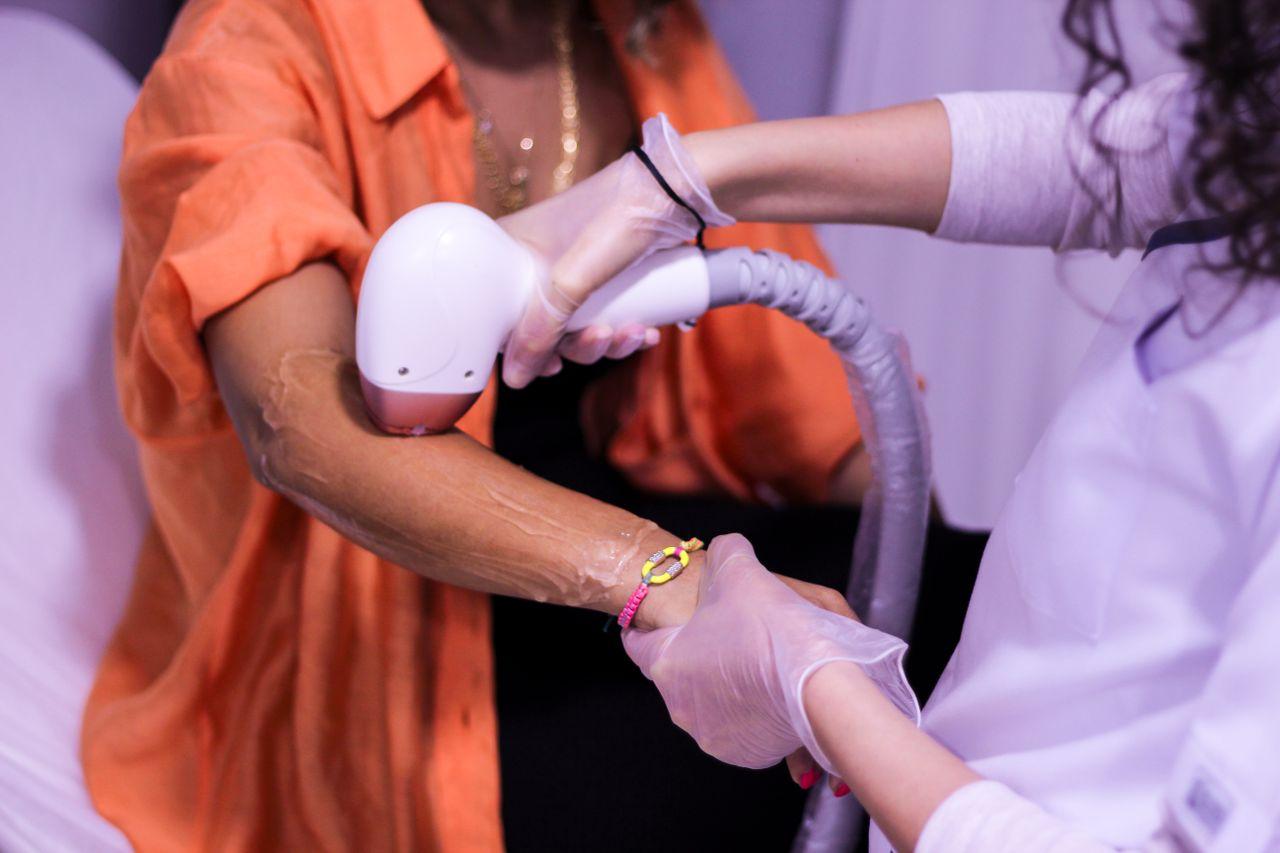
Medical practices typically use considerably more powerful therapeutic lasers, including Class 4 lasers. Because these lasers can deliver much greater optical power and potentially injure the eyes or skin if used improperly, they require appropriate safety precautions, training, and eye protection.
The LED lights utilized in at-home red light therapy devices don’t penetrate as deeply as high-intensity lasers. As such, they are typically marketed for surface-level applications (skin and hair) and general wellness.
That said, in my experience, I think red light therapy is also a great tool to use at home for mild pain issues.
Let’s say you know you have nagging shoulder pain. You want to keep your daily exercise routine, but you don’t want the pain to set you back. I see red light therapy as a great at-home tool for helping to reduce inflammation and improve cellular energy.
In contrast, I view the laser as a more powerful and focused treatment where we are trying to significantly improve a moderate or severe pain issue. I also see the laser as being able to provide longer-lasting relief than the red light therapy. (Keep in mind that this distinction is based on my own experience and is not necessarily substantiated by published research.)
This brings up one of the most common questions I receive: Should I just buy a red-light panel for my house?
My wife and I own a red-light panel at home. We have both used it extensively.
There is legitimate science behind photobiomodulation, including research using both lasers and LEDs. But that doesn't mean every red-light product on the internet has been proven to treat joint issues, tendon injuries, or pain.
The device, wavelength, dose, and condition being treated all matter.
How to Choose a Home Light Therapy Device
If you're considering a home device, I think there are several things to keep in mind.
First, choose a reputable device and understand what wavelengths it produces. Many panels combine visible red light, often around 630–660 nm, with invisible near-infrared light, commonly around 810–850 nm.
Second, consistency matters.
Light therapy generally isn't something I would try once or twice and then declare a success or failure.
If I were evaluating a home device, I would use it according to the manufacturer's instructions consistently for several weeks before deciding whether it was helping.
Finally, have realistic expectations.
A red-light device isn't a miracle treatment.
It may help reduce pain or improve function for certain conditions. However, the magnitude of benefit will likely depend on what problem you're treating, what tissue you're trying to reach, how deeply that tissue is located, and whether the device is actually delivering an appropriate dose of light to that tissue.
Home LED devices generally deliver much less optical power than the high-intensity lasers used in medical settings. That doesn't automatically make one "good" and the other "bad," or even prove that more power is always better.
It simply means they deliver light differently and shouldn't be assumed to produce identical effects.
For most healthy people, consumer red-light devices appear to have a relatively favorable safety profile when used appropriately. But they still need to be used as directed. Especially when it comes to eye protection, treatment duration, photosensitizing medications, and underlying medical conditions.
Putting It All Together
The science of light therapy is still evolving.
What I find most interesting is that an idea humans have experimented with for thousands of years is now something we can study at the level of individual wavelengths, photons, mitochondria, and cellular signaling.
We have learned a tremendous amount. But there is still much more to understand about which forms of light therapy work best, for which conditions, and at what dose.
In the meantime, I believe light therapy is an option worth considering if you’re dealing with nagging pain from regular physical activity or more intense residual pain from acute injuries or chronic conditions.
Especially for people in the latter category, high-intensity laser therapy in a supervised medical setting is likely the best place to start. Many pain specialists already offer these treatments, and they are becoming increasingly common.
That said, if you’re simply looking for a new approach to helping your body come back stronger after workouts or other physical activity, at-home red light therapy might be worth exploring.
Dr. Ro Mahajan, MD
Dr. Ro Mahajan received his MD from the University of Toledo College of Medicine in 2011. He has been double board-certified by the American Board of Anesthesiology in Anesthesiology and Pain Medicine since 2016.
Ro Mahajan MD trained in the nation’s top hospital systems, including the University of Michigan and UCLA. Today, he practices in two settings. He provides insurance-based mainstream medical care for pain-related conditions through one of the nation’s largest hospital systems.
He also offers natural and regenerative treatment options through Regenerative Orthopedix, a private practice in Fargo, North Dakota.
Ro Mahajan MD is a founding member of SaltWrap's Clinical Advisory Board.